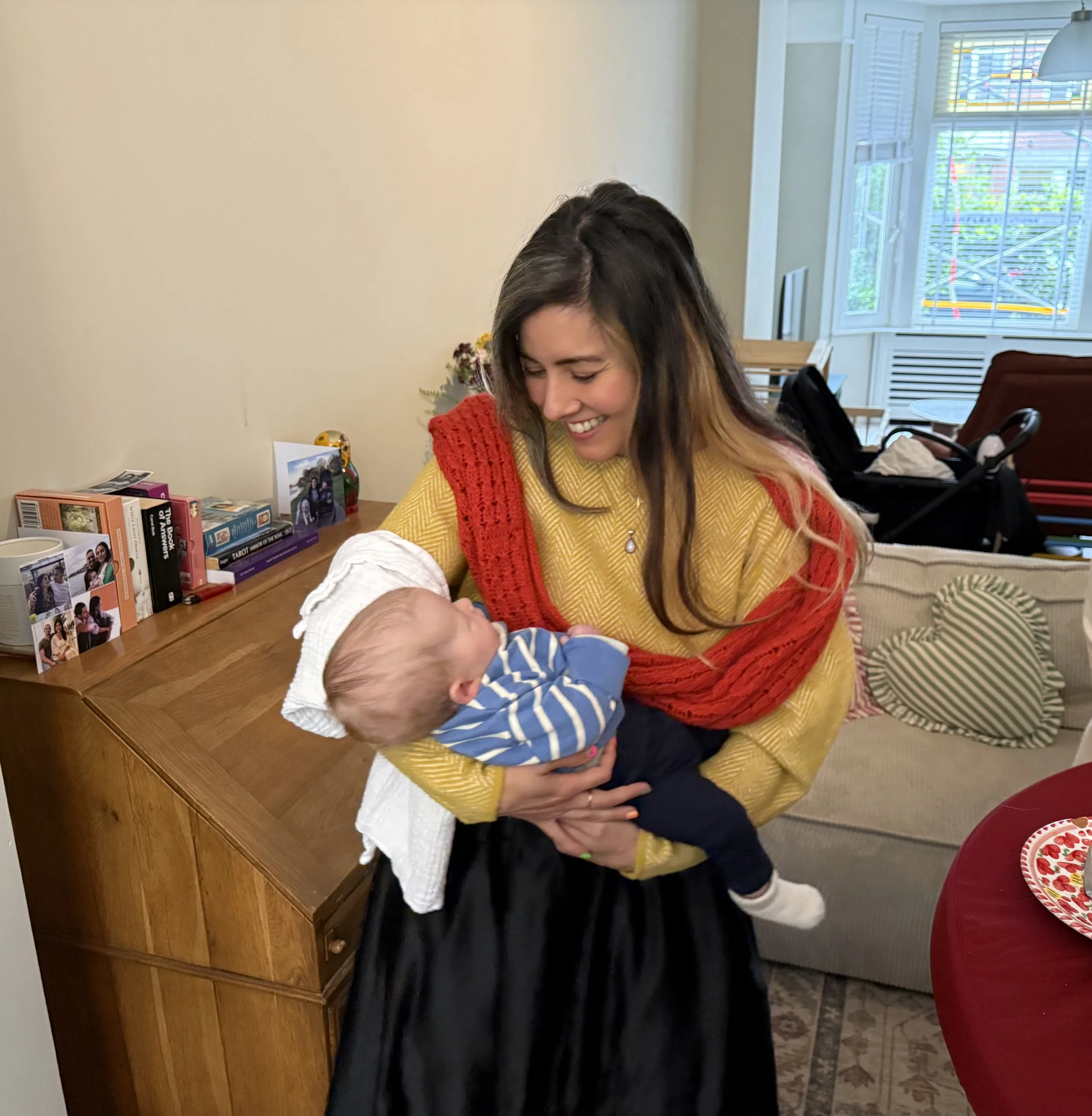
I attended my friends’ vow renewal ceremony that they held to commemorate their 10-year wedding anniversary. It was an intimate gathering of the friends they've made over the past four years of living in the Netherlands and I felt honored to be included. Celebrating love while fresh from a breakup is bittersweet so I knew heartache was in the cards for that day, I just didn’t expect it to come from a baby.
One of the couples at the ceremony had brought their 3-month-old son. We stood hovering over the rented cocktail table in the living room eating the finger food prepared by the caterers. The parents took turns holding him so the other could eat. I know this makes me sound like a sociopath but there are very few infants who I actually find adorable. Most just look like wrinkly old men, and this one was no exception. But I suppose what makes them so “cute” is how small and helpless they are, and the wonder we project onto them of the life they have yet to live. I guess I was staring at him for a while because the father didn’t ask so much as eagerly instructed me to hold him.
He was no longer just a baby in my arms but a portal to a part of my own story I hadn't been able to access before.
He handed me the towel that you drape over the arm where the head goes to catch any drooling or vomit. Then he carefully slid the squishy sack of chubs and bones into my arms. I can’t recall the last time I held an infant so young. We both squirmed a bit: me trying to offer enough support for his tiny body, him trying to find comfort in my inexperienced arms. Infants this young don’t have much capacity to maneuver or hold themselves up. They’re notoriously quick to get fussy when uncomfortable, so I was holding my breath. But we eventually found our groove and I gently swayed him side to side, mostly to dislodge my nerves through the movement but he seemed to like it too. He laid quietly and still, his mouth slightly agape, his eyes slowly getting heavy with sleep, completely unaware of where he was or who was holding him.
I looked at him curiously and tried to connect on a personal level like I do with everyone, but at his age, infants don’t have much self-awareness, let alone a sense of self. I held him, analyzing that he was slightly bigger than my small dog but twice as heavy. Then, quietly, a realization crept to the surface: by the time I was his age, I had already been separated from my mother for weeks. He was no longer just a baby in my arms but a portal to a part of my own story I hadn't been able to access before.
At 7 weeks old, my mother flew with me to Japan to leave me in the care of my grandmother and my aunt. There’s a photo of me in her arms, taken while she sat on the piano bench in her family home in Japan. The photo was dated May 20, 1987, two days before I turned two months old. Though still married, she was effectively a single mother. With maternity leave being non-existent, my father having complete disregard of finances, and her career being her lifeline, I imagine she was eager to return to work and earn her paycheck. On top of all this, she was still enrolled in a night-school MBA program.
My mother never talked about this time. I didn’t know we had been separated like this until I was 22. We were at a gathering where a 6-month-old was being passed around. When he came to her, she looked uncomfortable, holding him mid air with her arms straight out, unsure of what to do. I jokingly remarked, "Don’t you remember how to hold a baby?" She retorted off the cuff, saying she never held a baby at this age because she didn’t see me until I was nearly a year old. I was surprised when I heard this, but I didn’t register the weight of its implications until a decade later. It’s something I’m only now starting to actually unpack through my recent work with EMDR.
I don’t blame her for the choices she made. I sympathize with her motivations. And at the same time, even though I had no attachment to this baby (I never knew he existed before and I will probably never see him again), feeling how fragile he was, how utterly and completely dependent on everyone around him for all but breathing and keeping his heart beating, I felt my body hesitate when it came to letting him go. I can’t imagine how my body would react with my own child, let alone with leaving them behind, halfway across the world, even in trusted hands. While my mind understood, I felt my body say, “how could she?”
In place of cognitive memory, I recognize a somatic one: an awareness of a deep sense of loss warped in injustice.
I had studied developmental psychology and though early infancy was glossed over, it doesn’t take a genius to understand that a separation at this stage of development would impact a person. But to what extent, and how? I have no memory from this age because long-term memory only starts to slowly form from about 18 months. But in place of cognitive memory, I recognize a somatic one: an awareness of a deep sense of loss wrapped in injustice.
The realization stayed with me when I got home and remained when I awoke the next morning. The vague understanding of "a significant impact" wasn't enough anymore. I needed to understand exactly how this experience had shaped me, so I turned to AI to spell it out. What I read broke me.
“Abrupt separation causes acute physiological stress, disrupting the baby's emerging capacity to self-regulate…”
As I read, the distance between "clinical insight" and my “lived reality" began to collapse. What it described was essentially a kind of physiological shock, one that hasn’t been suppressed so much as, unbeknownst to me, continued to echo and reverberate within my bones.
It went on to explain my susceptibility to chronic anxiety and depression; how I’d create a defensive emotional wall to keep myself safe but would be incredibly lonely; it even laid out the difficulties I’d face forming long-lasting relationships, both romantically and platonically, due to my internalized belief that fundamentally, I’m a burden and therefore unlovable.
But the biggest gut wrenching revelation of all came in reading about my relation to my caregivers. Because I lacked that capacity for long term memory, whatever bond I had built with my mother had simply vanished, as if it never existed. And when I was taken away from my grandparents to live with my mother again a year later, my system registered this separation as a permanent loss, effectively the death of the only love I knew. I might as well have been handed to a complete stranger, one whose maternal bond with me had never developed. It finally clicked why I’ve always felt that I “missed” my caregivers, even when they were alive and right next to me; why my body ached for them; why I yearned for a bond I couldn’t recall ever having.
My list of shortcomings isn’t proof that I’m broken, they’re maladaptive coping mechanisms I fashioned together as best I could as a child.
With it all laid out so clearly, I’m finally able to read the writing that’s been on the wall. As difficult as it has been to face, I realize my experience is nothing out of the ordinary. I’m just a classic textbook case of C-PTSD. This simultaneously hurts but also feels… hopeful.
Gaining this definitive perspective rather than leaving it to mere abstract theory makes it easier to accept the undesirable aspects of myself. It directly challenges the belief I’ve held that I somehow deserve to struggle, to be alone, to be exempt from having “nice things” that seem to come naturally for everyone else. My list of shortcomings isn’t proof that I’m broken; they’re maladaptive coping mechanisms I fashioned together as best I could as a child. There are methods to my madness and for the first time, it doesn’t feel like a condemnation.
But understanding isn't enough. Realization alone won't prevent me from employing those behaviors. They are patterns that no amount of logic can break, only a different action.
All these years of therapy, self-reflection, and healing work, I thought I was further along my journey. I’m able to name my triggers, point to where they came from, and explain why I had them (even if vaguely). I’d share this with potential love interests, almost writing an instruction manual on how to “handle” me, like a profile of an animal waiting to be rescued from the shelter. And I’ve learned to carefully manage my environment; find comfort in rigidity; focus on growth at all cost, waiting for perfection. But I see now that these are just various forms of control, different sides of my coping mechanism dice. Despite my earnest, desperate attempts, inevitably, the triggers blast off and my house of cards falls apart. Avoidance maxxing at its core.
They say the only way is through, and for me, that means finally walking through the minefield instead of trying to assess and map every potential explosion.
So I now sit at the paradoxical crossroads between having deep compassion for myself and feeling emboldened to change. I accept that my brain is wired differently; that it vehemently believes a shoe will inevitably drop and that somehow it will be the worst thing that could possibly happen. I see the fear, the anxiety, the hypervigilance, and the grief, and I accept them. But I also have the license to rewire my brain, not to conform or be more palatable to others, but for myself, to have the chance at connecting with another as I did that first year of life.
They say the only way is through, and for me, that means finally walking through the minefield instead of trying to assess and map every potential explosion. Being triggered has felt like a major personal failing, a source of deep shame. But I'm starting to see now that it's not just a necessary part of the journey, it is the journey itself. There's no need to attune to every micro-expression, to overanalyze every interaction, or to fortify the wall around my heart, my hopes, my love.
Instead of putting all my energy into protecting myself from explosive disappointment, it’s about redirecting it: sitting with the discomfort, breathing through the panic, and offering myself the compassion that's been missing this entire time. I will still feel the pain, I will still cry, my heart will still break. And I will know it isn't the end of the world. I am just a human having a human experience. I will recover, and I am allowed to move on.
I don't know if I'll ever fully shed the hyper-independence, the hypervigilance, the anxious people-pleasing, the escapist daydreaming, or my dissociative tendencies. But my survival kit is expanding, and I'm learning to reach for others as I reinforce my internal gauge. This story has always been mine. And for the first time, I feel capable of carrying it.